
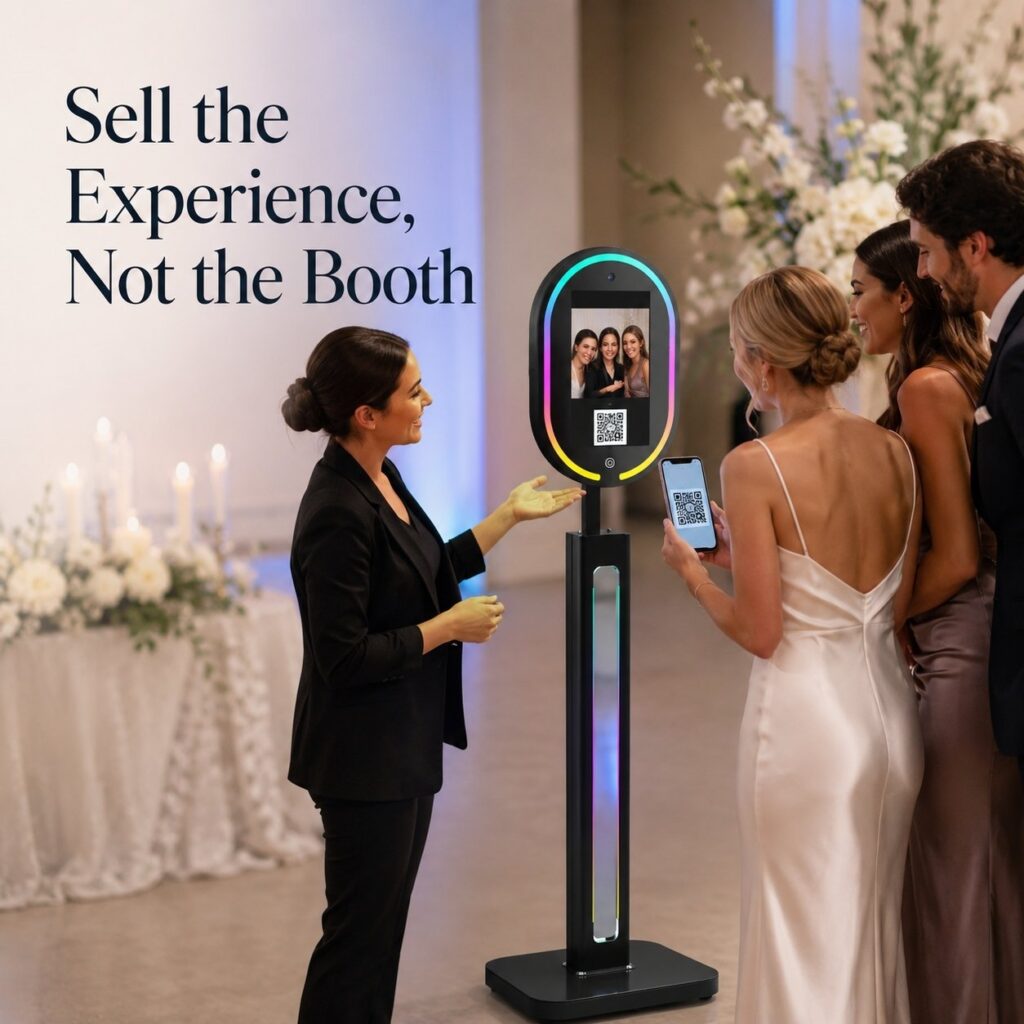
A customer asks, “How much do you charge for three hours?”
It is a familiar question for almost every photo booth rental business. The usual response is to send a price list with a device name, service hours, an attendant, unlimited sessions, and digital sharing.
That quote may be clear. It may also make your service look almost the same as everyone else’s.
If customers can only compare the booth and the number of hours, they will usually compare price. A stronger approach starts somewhere else: the event, the guests, the content, and the result the client wants to create.
Clients are not only buying a photo booth. They are buying guest participation, event memories, shareable content, brand visibility, and confidence that the event will run smoothly.
Why Equipment-Based Offers Become Commodities
A booth is easy to describe. A 360° Photo Booth, iPad Photo Booth, Magic Mirror, or robotic camera arm gives a client something concrete to picture. Service hours are also easy to compare.
The problem starts when the entire offer stops there.
Two companies may use different equipment, but their packages can still look almost identical:
- Two or three hours of service
- One booth or camera system
- One staff member
- Unlimited captures
- Digital sharing
None of these items is unimportant. They simply do not explain what the client’s guests will experience or what the client will receive after the event.
A piece of equipment is part of the experience. It is not the whole experience.
What Clients Are Actually Buying
The same photo booth can serve very different purposes. A wedding client, a birthday client, and a brand activation client may all ask for a Photo Booth, but they are not buying the same outcome.
| Event type | Main client goal | What the experience may include |
|---|---|---|
| Wedding | Help important people enjoy the celebration and preserve the day. | Friendly guest guidance, key group photos, simple sharing, and an organised delivery process. |
| Birthday or private celebration | Create a visual activity that feels personal and matches the theme. | Custom backgrounds, filters, stickers, short videos, and content that guests want to share. |
| Corporate or brand event | Increase participation and create useful branded content. | Branded templates, watermarks, consent or disclaimer steps, lead collection, sharing data, and a post-event summary. |
This is why the first sales question should not always be, “Which booth would you like?” A better first question is, “What should this activity help you achieve?”
Eight Questions to Ask Before Recommending a Booth
A discovery call does not need to sound complicated. In fact, simple questions often reveal more useful information than a long product presentation.
- What is the purpose of the event? Is it a wedding, a private celebration, a company event, a launch, or a public activation?
- Who are the most important guests? The answer may affect the space, staffing, capture style, and guest guidance.
- What do you want guests to feel? Fun, relaxed, surprised, involved, celebrated, or connected to the brand?
- What kind of content should guests receive? Still images, short videos, slow motion, branded clips, or a complete gallery?
- Where will that content be shared? Private delivery, social media, event screens, internal channels, or a campaign page?
- Is branding or lead collection required? If yes, clarify the brand assets, consent process, and information the client needs to collect.
- What would make the event feel successful? More participation, more content, a smooth guest flow, or a useful report after the event?
- What concerns do you have about the event? This question often reveals the real buying reason: space, timing, reliability, staffing, weather, or content delivery.
These questions also help you avoid recommending the wrong setup. A large 360° system may be exciting, but it may not be the right choice for a small venue with limited floor space. A simple iPad-based setup may be enough for one event, while a brand activation may need a more structured content and data workflow.
Turn Customer Answers into Experience Packages
Once you understand the event, you can turn the answers into a clearer package structure. The package names are not the important part. The important part is that each level explains who it is for and what problem it solves.
| Experience level | Suitable for | Focus |
|---|---|---|
| Essential Experience | Private events that need a reliable and simple activity. | Core capture, basic guest support, and clear digital delivery. |
| Social Experience | Events that want more visual energy and social sharing. | Theme-based visuals, AI effects, filters, dynamic stickers, and fast sharing. |
| Brand Activation Experience | Corporate events, launches, exhibitions, and promotional campaigns. | Brand content, disclaimers, consent steps, information collection, and basic engagement reporting. |
Notice what is missing from this structure: a long list of technical specifications without context. Specifications still matter, but they should support the experience instead of replacing it.
Show the Experience Before the Event
A client should not have to imagine the whole service from a device name. Your proposal can make the experience easier to understand with a simple visual story:
How does the setup fit into the venue?
What do guests see, do, and receive?
How quickly and through which channels?
What does the client receive after the event?
A useful proposal can include a similar event example, a sample background or template, a preview of the capture result, the guest sharing route, staffing responsibilities, and the final delivery format.
It is also worth explaining what happens when something does not go perfectly. For example, if the venue network is unstable, can tasks be handled offline and uploaded later? If the client has a specific brand requirement, when should the assets be approved? These details make the offer feel more real and more dependable.
Make the Experience Repeatable with ChackTok
Once you have defined the experience, the next challenge is delivering it consistently. A strong sales promise should not depend entirely on the owner remembering every step.
ChackTok is an interactive imaging software system brand built for event imaging and interactive device workflows. It can help operators turn an agreed experience into a repeatable process through features such as:
- Event templates for weddings, birthdays, brand events, and other common use cases
- AI Cutout for creating backgrounds that match the event theme
- Filters, dynamic stickers, and visual effects for content variation
- QR code, SMS, and email sharing for digital delivery
- Custom watermarks and disclaimers for branded or permission-based workflows
- Offline task queuing and batch content management for busy event environments
- Basic sharing and participation data to support post-event reporting
The software does not replace the operator’s judgment. It supports the workflow around the equipment, so the team can focus on the event and the guests.
For a practical overview of the platform, see how to use ChackTok.
A Simple Checklist Before Sending Your Next Quote
- Have I asked what the client wants the event to achieve?
- Do I know who the key guests or participants are?
- Have I explained the guest journey, not only the equipment?
- Does the package explain what the client receives after the event?
- Have I shown a visual example that matches the event?
- Are branding, consent, data collection, or sharing requirements clear?
- Can my team deliver this experience in the same way at the next event?
If the answers are clear, your quote becomes easier to understand. The client still knows what equipment is involved and how long the service runs, but those details now sit inside a more meaningful offer.
Conclusion
Better positioning does not begin with charging more. It begins with giving clients something more useful to compare.
When you sell a complete photo booth experience, the conversation moves from “How much is the booth?” to “How will this help our event?” That change gives your expertise more room to show.
Before sending your next quote, start with the client’s event—not the booth.
Build your next photo booth experience with ChackTok.
Explore ChackTokFrequently Asked Questions
What is a photo booth experience?
A photo booth experience is the complete customer journey around the booth, including event planning, guest participation, capture, content processing, sharing, and post-event delivery.
How should I package photo booth services?
Build packages around the client’s event goal. Explain who each package is for, what guests will experience, and what the client will receive after the event.
How can photo booth operators reduce price comparisons?
Ask discovery questions before recommending equipment. When the proposal shows the full event experience, clients have more meaningful factors to compare than hours and device type.
What role can photo booth software play?
Photo booth software can support templates, device workflows, image processing, digital sharing, content management, and basic event data collection. The exact workflow depends on the supported device and event setup.